| maciek72 | 17 Aug 2012 5:00 a.m. PST |
I've read a bit about Confederate kepi and sleeve insignia system, but still I'm confused.
Could anybody explain this system in mid-war ? |
| Rhino Co | 17 Aug 2012 5:26 a.m. PST |
Google is your friend link |
| John the Greater | 17 Aug 2012 5:51 a.m. PST |
More, from Wikipedia link As a general rule, the thicker the braid the higher the rank. For early war many of the officers used the same rank system as the federals. |
| maciek72 | 17 Aug 2012 6:04 a.m. PST |
Thanks guys.
I know the links you provided. But it not so easy. One can claim that first lieutnants wore red sleeves during the course of war Was it true ? And what was the colour of his kepi, given he was an infantryman ? And generals – they had buff coloured sleeves ? So why all pictures show them with white coloured sleves and colar ? |
| ciaphas | 17 Aug 2012 6:32 a.m. PST |
as far as i am aware the regimental officers ie. upto colonels would wear branch coloured sleaves and caps, infantry being blue, cavalry yellow artillery red, staff officer were buff and these could be of any rank, and as stated the early war ranks were the same as federals with the later austrian braid being the more decorative and thick the higher the rank aswell as the stars on the collar for generals etc. hope that helps alittle
jon |
| maciek72 | 17 Aug 2012 6:42 a.m. PST |
@ciaphas
But this is contrary to the link from Wikipedia. |
Shagnasty  | 17 Aug 2012 7:07 a.m. PST |
It is Wikipedia. Because it is on the internet does not make it true. My knowledge from reenacting parallels Ciaphas above. |
ScottWashburn  | 17 Aug 2012 7:16 a.m. PST |
Yes, the color denoted the branch (lt blue=infantry, red=artillery, yellow=cavalry, etc.) and the number of rows of braids on the sleeve denoted the rank (in addition to the collar insignia). The Federals sometimes used a similar sort of braid in black on kepis and the officers greatcoat to denote rank, too. |
| firstvarty1979 | 17 Aug 2012 7:33 a.m. PST |
I think you are mis-reading The Wikipedia image. It's not wrong, just confusing. The colors shown are EXAMPLES of the rank and branch as they would be used together. The colors assigned to each branch should have been broken out into a seperate box for clarity. Instead, they are provided adjacent to where they are used as an example in parallel with one particular rank. (I also think they should have the General and Staff officers in off-white as that was the predominant color they used.) From top to bottom you have a: General Officer
Colonel of Infantry
Lt Colonel as a Staff Officer
Major serving in the Medical Dept
Captain in the CS Marine Corps (Not many of them!)
1st Lt in the Artillery/Ordnance Dept
2nd Lt in the Cavalry |
| ACWBill | 17 Aug 2012 7:34 a.m. PST |
The uniform regulations were largely ignored by most rank and file officers. The material required for such fanciful coats was expensive and more rare as the war went on. A good example is the fact that Robert E. Lee wore a CS Colonel's insignia throughout the war. In 1861, many CS officers simply wore the blue coats they wore while members of the US Army. By 1864, many infantry Lieutenants and Captains wore the same uniforms as the private soldiers. In the western theatre, almost anything goes. In fact, US officers were most often to be found wearing the ubiquitous sack coat with rank insignia sewn on, if worn at all. The appearance of ACW troops on campaign would have been driven by what was available. For most CS troops, that was the shell jacket. For the US, the sack coat. |
| maciek72 | 17 Aug 2012 7:36 a.m. PST |
@firstvarty1979
Good point. It makes sense. |
| firstvarty1979 | 17 Aug 2012 9:29 a.m. PST |
"The material required for such fanciful coats was expensive and more rare as the war went on. A good example is the fact that Robert E. Lee wore a CS Colonel's insignia throughout the war." That would actually be a poor example, since Lee was certainly financially able to wear the most elaborate uniforms he could desire. His choice to wear a Colonel's rank was clearly deliberate. I don't think you can fairly call the CSA uniform regs "fanciful", since there ARE plenty of surviving examples of them. Uncommon, maybe, but they were not unknown. Regarding Union junior officers wearing mostly sack coats in 1864, I think there is compelling photographic evidence, and surviving uniform examples, that there were still plenty of frock coats being worn, even by company officers. I would go far as to say that it was the more likely unform worn by infantry officers. Google "Union Officers 1864" for Images and you get:
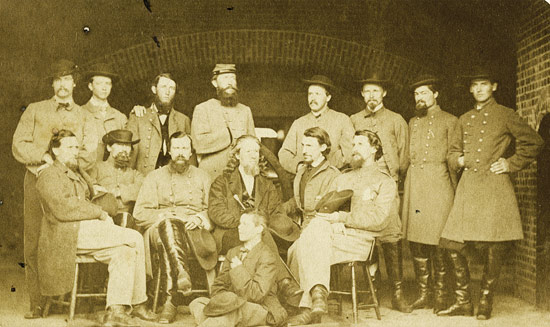
This last one is kind of neat, imprisoned Confederate officers at Fort Delaware in April 1864:
Example Confederate Artillery Captain's coat:
link |
| HammerHead | 17 Aug 2012 10:10 a.m. PST |
ummm what is so confusing about it? I guess its easier to ask than research yourself |
| donlowry | 17 Aug 2012 10:29 a.m. PST |
I thought you were asking about the "Austrian knots" on their sleeves and kepi. The system was one loop for lieutenants, two for captains, 3 for field-grade officers (majors, lt. cols. and colonels) and 4 for generals. I've never understood why Lee's stars were not surrounded by the wreath of a general -- but that was only on his every-day coat he wore in the field. His dress uniform, that he surrendered in, did have the wreaths, I believe. Both sides used the same arm-of-service colors (the CSA simply copying what all their officers were familiar with from the USA) with a few rare exceptions, such as the buff for generals and staff, which was black or very dark blue in the USA. Early CSA regulations called for the kepis to be of the arm of service color, with a dark blue band around the bottom (copied from the French kepis, which were red with a dark blue band around the bottom -- identical to the CSA artillery kepi). These being a bit gaudy for field wear (especially the red and yellow versions) the style changed later to gray kepis with a bottom bank in the arm-of-service color (but often solid gray). Generals' kepis (and trousers) were supposed to be dark blue, as worn by "Pickett" in the movie Gettysburg. |
| Old Contemptibles | 17 Aug 2012 10:32 a.m. PST |
What officers wore in the field is very different than what they carried with them for special occasions. Lee's full dress uniform worn at Appomattox and other tunics etc.:
link
|
| firstvarty1979 | 17 Aug 2012 11:00 a.m. PST |
Officers wore their "dress" uniform on the battlefield, there usually was no difference. Lieutenant Francisco Moreno Confederate Officer's Uniform
Authentic Civil War uniforms are huge with collectors, especially ones that can trace their provenance to the original owner. Cuban-born Francisco Moreno, who served with Confederate General P.G.T. Beauregard, was a member of a prominent Florida family. Moreno was later killed in action in 1862 during the Battle of Shiloh while wearing this New Orleans-made uniform, with blood stains attesting to the fact. Passed down by the Moreno family, this first lieutenant officer's frock brought $77,675 USD at auction.
|
| Frederick | 17 Aug 2012 11:10 a.m. PST |
As noted, branch colours applied to field officers; while they tended to be used less and less as the war progressed, gunners and cavalry officers were more likely to use branch colours General officers indeed had buff cuffs – they look white on the old photographs |
| Old Contemptibles | 17 Aug 2012 11:55 a.m. PST |
"Officers wore their "dress" uniform on the battlefield, there usually was no difference."
Well apparently Lee and Grant didn't wear their dress uniform on the battlefield. Lee change into his finest uniform to surrender his army. A.P. Hill wore a red calico hunting shirt in battle. |
| maciek72 | 17 Aug 2012 1:08 p.m. PST |
Thank you all for interesting discussion ! |
| TKindred | 17 Aug 2012 1:34 p.m. PST |
Grant's "Private's bl;ouse" was NOT in fact an issue sack coat. In the National Archives, in the HQ's documents collection for Grant's HQ is a receipt from a NY clothier for delivery to him (and his staff) of an order of "blouses". This order was placed by Colonel Babcox and was for commercial or "private purchase" sack coats for Grant and his staff to relieve them of the the wear and tear on their dress coats while at Petersburg and elsewhere. Many officers had similar coats for use on campaign. While similar in nature to the issue fatigue blouse, these commercially produced coats were usually of a finer and lighter grade of wool, many with silk or cotton tape edging, and with 2-4 outside pockets. Most were also longer than the issue coat, and virtually all were lined in body and sleeves. If you at look at firstvarty1979's pics, the 3rd image down, the officer on the far left is wearing one of these commercial blouses, and this is the coat that Grant and his staff was wearing at Petersburg, and which many many Federal officers, both east & west wore on campaign. |
| TKindred | 17 Aug 2012 1:40 p.m. PST |
Back to the original discussion. Although CS regulations specified branch colors, this wasn't always followed, especially early in the war. For example: Although black was the color for staff officers (and medical officers), it was also the infantry branch color for officers from Texas, Georgia and Alabama. Indeed, even enlisted uniforms with this trim could be found among the soldiers from thos states, and independently raised units of ALL states. In Mississippi, red was used to designate infantry, and that is one of the reasons that Barksdale's kepi was of that color. So was Pickett's at Gettysburg, though he was a Virginian, and Beauregard also had a red kepi. All of these items are very much a person/unit/time/place sort of thing. Although the regulations are there and available for all to read, as with their Federal counterparts, CS officers were required to purchase their own clothing and equipments, and as such, a great deal of latitude was found throughout all of their clothing, and through all of the years of the war. |
| firstvarty1979 | 17 Aug 2012 1:57 p.m. PST |
You can't apply the infomation known about Lee and Grant's having multiple uniforms to the clothing situation of thousands of other officers serving under them – clearly their circumstances differed. We have one side saying they are all wearing private's clothing and the other saying that they all had two uniforms, one for every day wear the other for "special occasions." I would contend that the majority of the officers, who would have been Captains and Lieutenants, had one uniform that they wore almost all of the time, supplemented by civilian and quasi-military items, including hats, pants and coats made for them at their own expense. Oh, and I agree 100% with what TKindred posted. |
| donlowry | 18 Aug 2012 10:45 a.m. PST |
Certainly there is a big difference between a lieutenant and a commanding general, but there were many other grades in between, such as other generals, colonels, etc. The big dividing line would have been how much baggage they were allowed to bring along on campaign -- the higher the rank/position the more they got. Black trimmings were also used by many CSA cavalry units -- the 1st VA Cav., for instance. Apparently it was a favorite militia color, especially for units that had gray coats. |
| Bottom Dollar | 18 Aug 2012 11:52 a.m. PST |
OK. Different tangent. How did those guys, especially the officers not pass out or get sun stroke when it was 100 degrees and humid out. It's bad enough in the mid-Atlantic during the summer, but the deep South has got to be a BEAR. I was in NC in October once and wow it got hot even then. The sun's rays are much more direct. I couldn't imagine in July. I just don't see how the ordinary soldiers could march 20 miles and fight battles in summer time heat wearing all that clothing and gear. Then you've got officers bundled up like winter time when its 95 and humid. I don't see how they did it. |
| Cleburne1863 | 18 Aug 2012 12:46 p.m. PST |
First, I think the population was much more used to being outdoors than we are now. They didn't have air conditioning. They were used to spending most of their time working outdoors on a farm, or just being outdoors in general. Even factory workers and those in the city still had to deal with heat trapped indoors, and again, they didn't have AC. Second, many did pass out. Reading about Deep Bottom in 1864, for example, it seemed like most of the Union strength must have collapsed and died from heat stroke before getting into battle. I know that's an exaggeration, but it was a significant factor in the available strength of the Union forces during the engagement. Many, many soldiers collapsed along the line of march. It was just an everyday thing. It gets mentioned occasionally, but it was just as often so common it didn't get written down. Assuming they didn't die, they just rested, and caught up to the regiment later. Then again, many did die or had to be hospitalized. |
| Bottom Dollar | 18 Aug 2012 3:14 p.m. PST |
Maybe at Deep Bottom the officers should've said "OK. Boys, take the dark blue coats off while we're marching!" Maybe when it got real hot out they were allowed to do that ? And even then, if it is real hot you're still going to have men go down even if they've removed a few layers from the heat. I guess my question is, did they always go around in 100 degree weather with their collars buttoned at the top ? Or is that just what they did for the cameras ? |
| firstvarty1979 | 18 Aug 2012 7:58 p.m. PST |
Having reenacted years ago at events where there were fairly lengthy marches under very warm conditions (125th Manassas among them), a LOT of reenactors fell out because of the heat. I think in 1861 there was a similar result, since neither side's troops were much used to marching long distances at that point. Reenactors who were in similar physical condition, and of a similar age as the more hardened veterans of 1862-65 did fine as long as they drank water. Older guys had a harder time of it, as you might expect. I don't have data, but I'm guessing that the Militia formations of 1861 were had a higher average age than a year or more later so would have had a harder time of it. |
| TKindred | 19 Aug 2012 3:46 a.m. PST |
Natural materials such as wool, cotton & linen breath much more than artificial materials such as polyester & rayon. The natural materials wick the sweat off the body and bring it to the surface of the clothing where it evaporates and helps somewhat to cool the body. Your body's natural heat regulator is sweat which is evaporated by either the sun or any slight breeze, the effect of which is to draw heat away from the body and help to cool you down. If you remain hydrated, you are unlikely to suffer severe effects of heat. One of the reasons that tin canteens were covered with wool of jeans cloth material is exactly this: evaporation helped to keep the contents at least lukewarm, if not cool for a longer period, especially when filled from running water or wells where the cloth was well and truly soaked while filling. People and soldiers DID get hot and many fell by the wayside. Straggling wasn't frowned upon as long as the men were making an effort to return to their units. It was the stragglers (the coffee coolers) who were looking to get OUT of marching, to get OUT of a fight who were dealt with harshly. Those, however, who had heat-related issues were treated as best as possible and helped along their way. In the end though, people didn't know any other way of life. There was no refrigeration, no air conditioning, no man-made fabrics, shorts, tee-shirts per se, etc. Men & women alike made do as best as possible because there was nothing else they could do. It was the way life was, and it is still that way in some places of these United States. |
| Bottom Dollar | 19 Aug 2012 9:37 a.m. PST |
I was wondering if the breath-ability of clothing back then was better. But I also wonder if it was a question of culture as well. To be fully clothed was to be civilized. To not be fully clothed was to be a savage. But as a soldier living or camping outside in the elements nearly year round,or even as a farmer, getting used to wearing things with maximum protection from the elements that were still comfortable was important. Now it must have been hot this day. August in Virginia, 1862. link Their uniforms look like they would've been sweltering, but they look pretty relaxed and comfortable, so they must have been breathable and airy all the same. |
| donlowry | 19 Aug 2012 10:42 a.m. PST |
Being in good condition and not overweight certainly helps. I went thru USAF officer training school near San Antonio TX in the summer of 1962 (no, not 1862!) and never had any problems with marching, doing PT, etc. in the heat and humidity. I was pretty thin in those days. But a few men did. A few even fainted while standing in formation during our graduation ceremony. and that was while wearing short-sleeved shirt uniforms (no jacket). |
| Bottom Dollar | 19 Aug 2012 1:37 p.m. PST |
I lived in an apartment without AC for two years. Your body does get somewhat aclimated to the humidity (NYC), but it is never really comfortable and I'd take like 2 – 3 showers a day when I was home the whole day. Yeah, if your fit, skinny and it helps to be young. link The guy on the left looks like he'd be real comfortable marching in the heat. He took his coat off I think. I'm assuming that shirt is made of cotton, not wool. And firstvarty, I'm surprised more guys who have reenacted haven't mentioned anything. But your point about being fit for marching duty makes sense. And the generals could be very particular about marching, like they probably made sure to take precautions when it was hot. There was probably a sanitary component to the whole thing. You never knew when you were going to get a chance to wash up, so better to have as much grime on your clothes than on your skin. |
| ACWBill | 20 Aug 2012 5:52 a.m. PST |
It always amazes me that no matter what the subject on TMP, advice, however thoughtfully given, usually becomes contentious. I gave an example of regulations being ignored, which I consider to be a good one. Imagine my surprise that it turns out to be a poor one. |
| TKindred | 20 Aug 2012 8:49 a.m. PST |
Not to worry Bill, I get stifles and PM's for stuff I post, and the PM's aren't normally the sort you'd expect from nice folks. |
| Bottom Dollar | 20 Aug 2012 11:04 a.m. PST |
I was going to post something after what you said Bill. My understanding is officers in the frontlines didn't want to wear anything too conspicuous cause then they would get themselves singled out. Your explanation makes perfectly good sense to me. |
| firstvarty1979 | 20 Aug 2012 12:54 p.m. PST |
ACWBill, I think my statement was hardly "contentious", but rather a fair assessment of what you wrote. Looking back at it again, if you don't mind: The uniform regulations were largely ignored by most rank and file officers. The material required for such fanciful coats was expensive and more rare as the war went on. A good example is the fact that Robert E. Lee wore a CS Colonel's insignia throughout the war. The first sentence is a statement that you qualify twice ("largely" and "most"), rendering it meaningless. More importantly, those regulations weren't followed by the states and their individual regiments, so naturally the officers uniforms wouldn't follow them either. I don't think you can justify your next sentence as anything more than opinion. Many, many studies have been done, where it was found that the Confederates were uniformed, depending on their circumstances even BETTER at the end of the war than they had been previously. There are enough surviving officer uniforms from late in the war that demonstrate this. Finally, I stand by my statement about Lee wearing his Colonel's rank being a poor example of material deficiencies within the Confedeacy being the reason he wore that rather than Genderal's insignia. (If you are saying it was an example of him ignoring regulations, well, he was hardly a "rank and file officer".) Others have pointed out that Colonel was the highest rank he obtained in the U.S. Army prior to his resignation, and that was the likely reason he retained that rank on his uniform well after he received promotion to General. And someone else linked to the uniform he wore at Appomattox with Confederate General's rank on it. Surely in 1865 such a uniform would be harder to obtain than in 1863 if your example is valid? |
| donlowry | 21 Aug 2012 11:08 a.m. PST |
Others have pointed out that Colonel was the highest rank he obtained in the U.S. Army prior to his resignation, and that was the likely reason he retained that rank on his uniform well after he received promotion to General. It was not likely that he wore a gray coat while a colonel in the U.S. Army. However, he was a major general in Virginia's army (in fact its general-in-chief) after leaving the U.S. Army and before Virginia joined the Confederacy. I don't know what his rank insignia would have been then, does anyone? |
| firstvarty1979 | 21 Aug 2012 11:35 a.m. PST |
I wasn't clear. I meant that when he was promoted to General in the Confederate Army, he may have kept the Colonel rank on that uniform because that was his "official" U.S. Army rank, and perhaps he thought of it as a "Brevet" promotion, which was common during the war in the Union army. If you can believe Wikipedia, it says this: Robert E. Lee wore this insignia due to his former rank in the United States Army and refused to wear the insignia of a Confederate general, stating that he would only accept permanent promotion when the South had achieved independence. Lee may have been like Jackson and others who wore their U.S. uniform in the early part of the war, since Confederate uniform standards were still being written. |
| donlowry | 22 Aug 2012 11:27 a.m. PST |
I have my doubts about that Wiki quote. Does it cite a source? And I again point out that his dress uniform did have the correct insignia for a general, which it would not have if this quote was accurate. |
| firstvarty1979 | 22 Aug 2012 1:38 p.m. PST |
I agree with your doubts, but there is probably more to the story of why Lee's usual uniform had Colonel's rank. |
| Bksob69 | 24 Aug 2012 4:27 p.m. PST |
I have read that there was a belief amongst General Lee's officers that the reason he wore 3 plain stars with out the wreath was because of his lack of vanity, and also due to the high esteem in which he had for General Scott, who he served under in Mexico. Also his boyhood hero was no less then George Washington who also wore three stars…so perhaps it was some sign of respect, his humbled nature or a bit of both. Lt. Col. Fremantle describes Lee as such: "He generally wears a well worn long gray jacket, a high black felt hat, and blue trousers tucked into his Wellington boots. I never saw him carry arms, and the only mark of his military rank are the three stars on his collar. He rides a handsome horse, which is extremely well groomed. He himself is very neat in his dress and person, and in the most arduous marches he always looks smart and clean" I think this is about the best description I have ever read, well it is at lest my favourite. But… Besides Lee I have also read an account of someone meeting A.P. Hill, and describing him, saying that he would not have known he was a general because he was very skinny and sickly looking and didn't dress much like a soldier wearing a old worn out brown coat. He is also pictured wearing 3 plain stars much like Lee…just food for thought. |
| Bill N | 24 Aug 2012 7:38 p.m. PST |
The pics I've seen of A.P. Hill all have him wearing Col. insignia. Only one ACW era pic shows him wearing an official style uniform with buff colar and cuffs. |
| donlowry | 25 Aug 2012 12:50 p.m. PST |
It could be that Lee acquired that coat before the CSA regs were published, or known to him. Stars were certainly NOT used for field-grade officers in the old Regular Army. At first the CSA had only 2 ranks for general officer (IIRC), brigadier general, and general. Later they added major general, and still later then added lieutenant general. So possibly, early on, 3 stars was, or was thought to be, the emblem of a full general before there were lieutenant generals, or even major generals, and before the regs stated that all generals would wear 3 stars surrounded by a wreath. Just guessing, of course. |




 completes a Confederate river ironclad.